
Does Thicker Balsamic Vinegar Mean Better Quality?
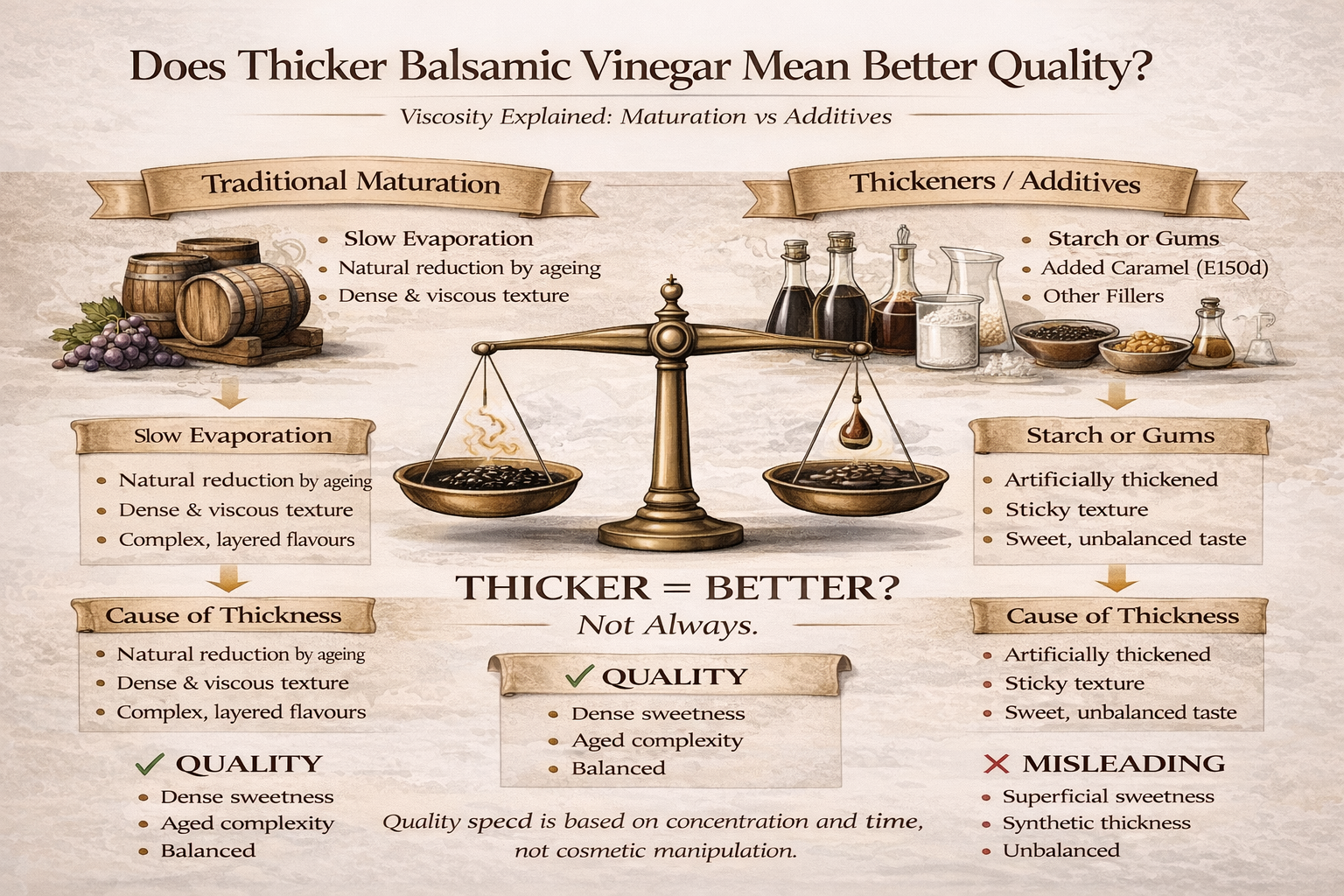
Many consumers assume that thicker balsamic vinegar is automatically better.
The visual cue of density — slow movement, syrup-like texture — is often associated with ageing and quality. However, thickness alone does not determine excellence.
To answer whether thicker balsamic vinegar means better quality, we must examine what creates viscosity in the first place.
What Makes Balsamic Vinegar Thick?
Balsamic viscosity can result from several different factors.
The most important are:
| Cause of Thickness | Mechanism | Quality Indicator? |
|---|---|---|
| High grape must concentration | Natural sugar density | Often yes |
| Long barrel ageing | Evaporation increases density | Yes |
| Added caramel (E150d) (industrial products) | Colour stabilisation only | No impact on texture structure |
| Added thickeners (industrial products) | Starch or gums | No |
True density develops through concentration and time.
In traditional production, grape must is reduced before fermentation. During ageing, water continues to evaporate through wooden barrels, naturally increasing viscosity.
For a scientific explanation of this process, see our pillar article on the science of balsamic vinegar.
Traditional DOP: Thickness Through Time
In:
Aceto Balsamico Tradizionale di Modena DOP
Aceto Balsamico Tradizionale di Reggio Emilia DOP
Thickness develops naturally.
Years of ageing in wooden barrel batteries cause:
Water evaporation
Sugar concentration
Increased density
Structural complexity
No thickeners or additives are permitted.
In this case, thickness is indeed associated with maturation.
IGP Products: Thickness Depends on Formulation
Under the specification for Aceto Balsamico di Modena IGP, producers may blend cooked grape must with wine vinegar.
Viscosity therefore depends on:
The percentage of cooked grape must
Ageing duration
Reduction method
Caramel (E150d) may be added for colour stabilisation, but it does not significantly affect texture.
Higher must content typically results in thicker consistency.
However, some commercial products may appear thick for reasons unrelated to ageing.
Thickness vs Sweetness
Consumers often equate thickness with sweetness.
While higher sugar concentration can increase density, the relationship is not absolute.
| Texture | Possible Cause | Interpretation |
|---|---|---|
| Very thin | High wine vinegar ratio | Sharper, less sweet |
| Moderately thick | Balanced must content | Structured balance |
| Very thick | High must or long ageing | Potentially higher quality |
| Artificially thick | Additives | Misleading |
Sweetness, acidity, and viscosity must be considered together.
For a deeper explanation of sugar concentration and fermentation, see our article on why balsamic vinegar is sweet.
When Thickness Can Be Misleading
Thickness alone cannot confirm:
Ageing duration
Ingredient purity
Must percentage
Production philosophy
A syrup-like texture does not automatically indicate long ageing.
The only reliable way to evaluate quality is to review:
Ingredient declaration
Regulatory designation
Producer transparency
Our guide to how balsamic vinegar is made explains how production stages influence structure and flavour.
The Role of Evaporation
During barrel ageing, natural evaporation increases density over time.
This process is well documented in traditional balsamic production systems maintained by the Consortia in Modena and Reggio Emilia.
Evaporation — not additives — is the authentic cause of density in traditional products.
So, Does Thicker Mean Better?
Not automatically.
Thickness may indicate:
Higher grape must concentration
Longer ageing
Greater structural density
But it can also result from formulation choices unrelated to traditional maturation.
Quality is determined by ingredient integrity, ageing method, and balance — not viscosity alone.
A well-made balsamic vinegar should demonstrate:
Integrated sweetness
Clean acidity
Aromatic complexity
Structural harmony
Texture supports quality. It does not define it.
Final Perspective
Does thicker balsamic vinegar mean better quality?
Sometimes — when thickness is the result of concentration and time.
Not always — when thickness is the result of formulation choices alone.
Understanding the science behind viscosity allows consumers to evaluate balsamic vinegar beyond visual cues.