How Is Balsamic Vinegar Made
Many buyers enjoy the taste of balsamic vinegar, yet far fewer understand the transformation behind it.
When people ask how is balsamic vinegar made, they are often surprised to discover how much patience, biology and environmental influence are involved.
Production is not a single action but a sequence of stages that reshape grape juice into a stable, aromatic condiment. Each step contributes to texture, balance and identity.
The journey begins in the vineyard
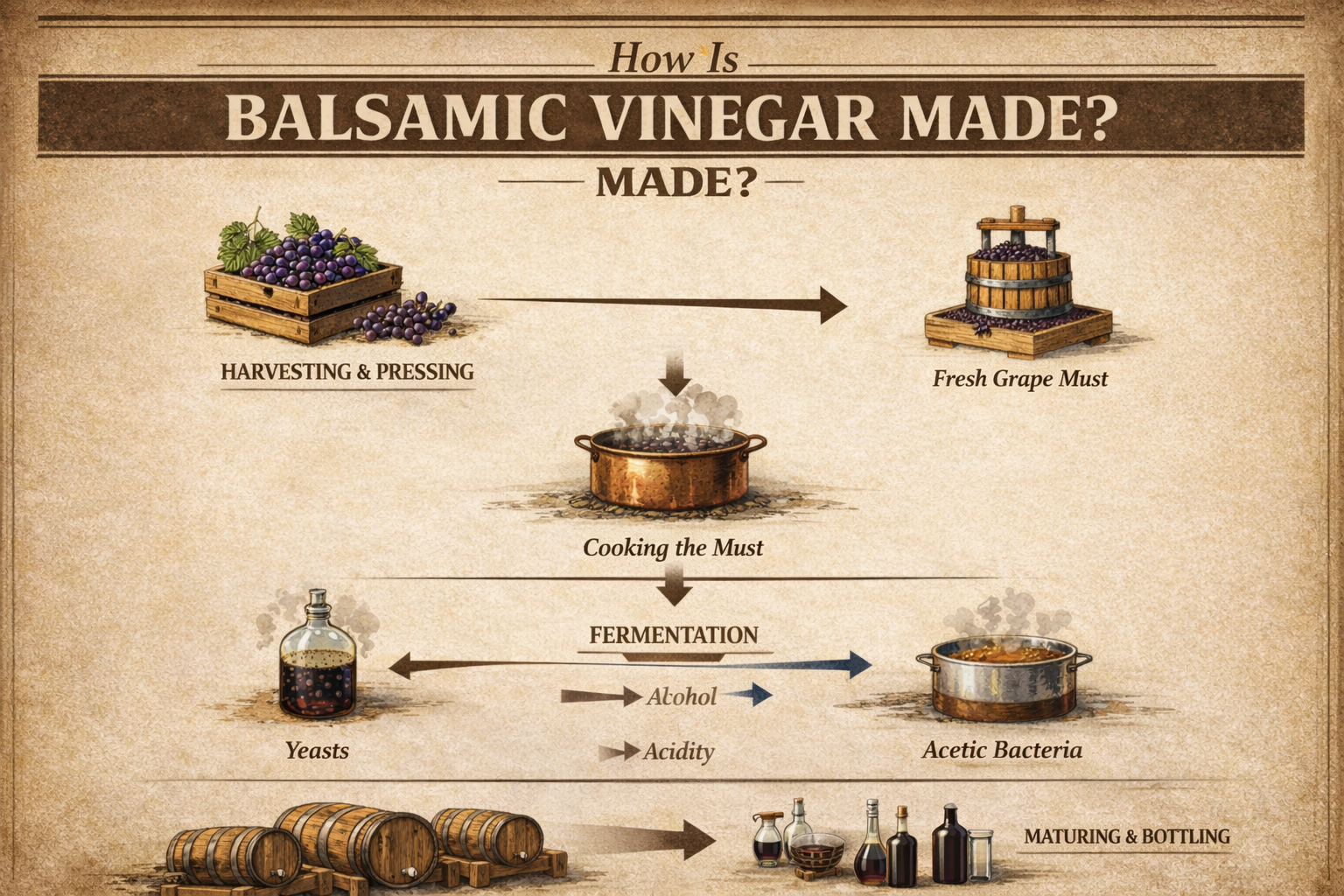
To explain how is balsamic vinegar made, it is impossible to ignore the starting point: grapes.
Sugar concentration, acidity and aromatic potential of the fruit define what can be achieved later. Harvest decisions, ripeness and variety therefore influence structure long before aging begins.
Once collected, grapes are pressed to obtain must — the raw material that drives the entire process.
Cooking the grape must
A fundamental moment in understanding how is balsamic vinegar made is the cooking of the must.
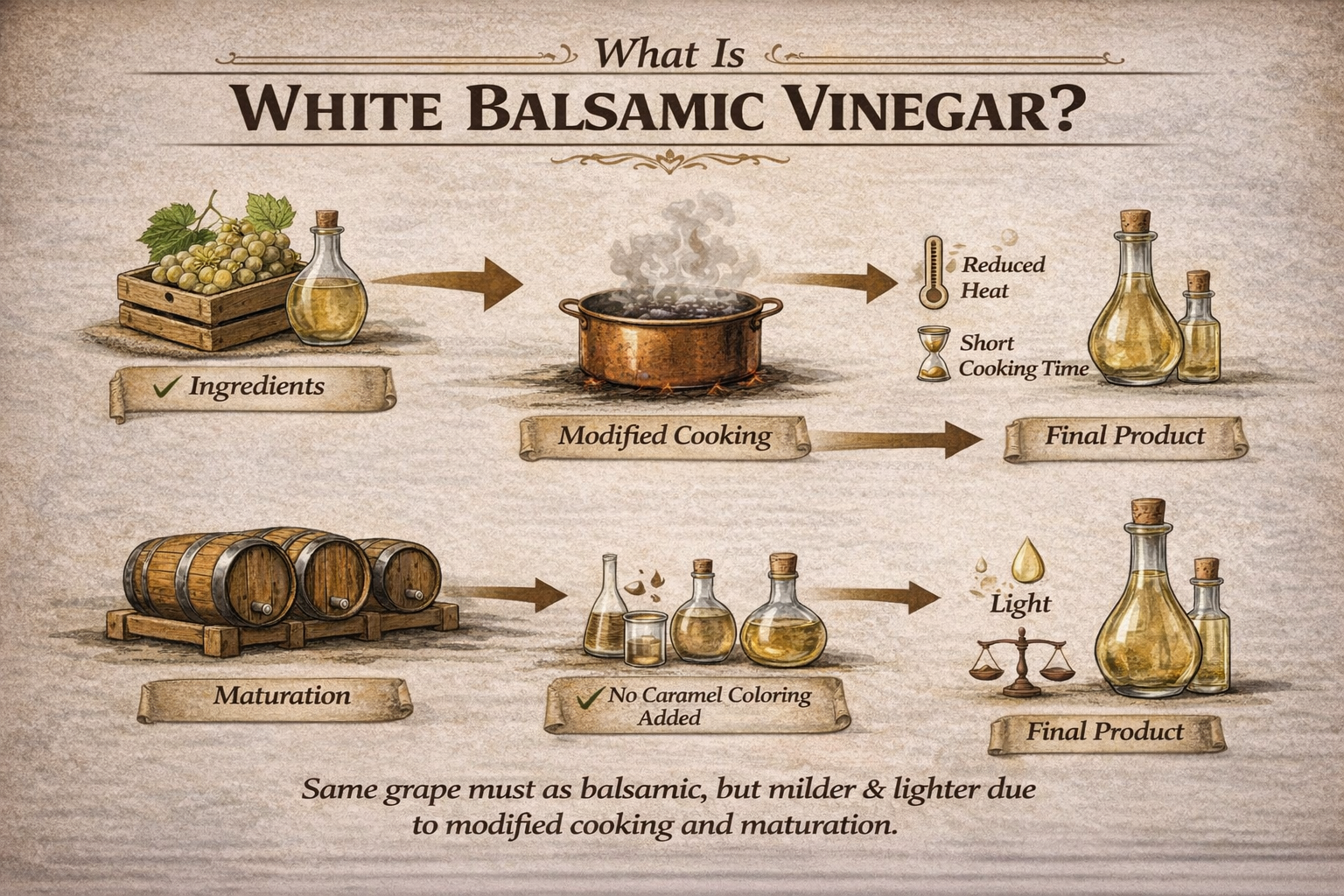
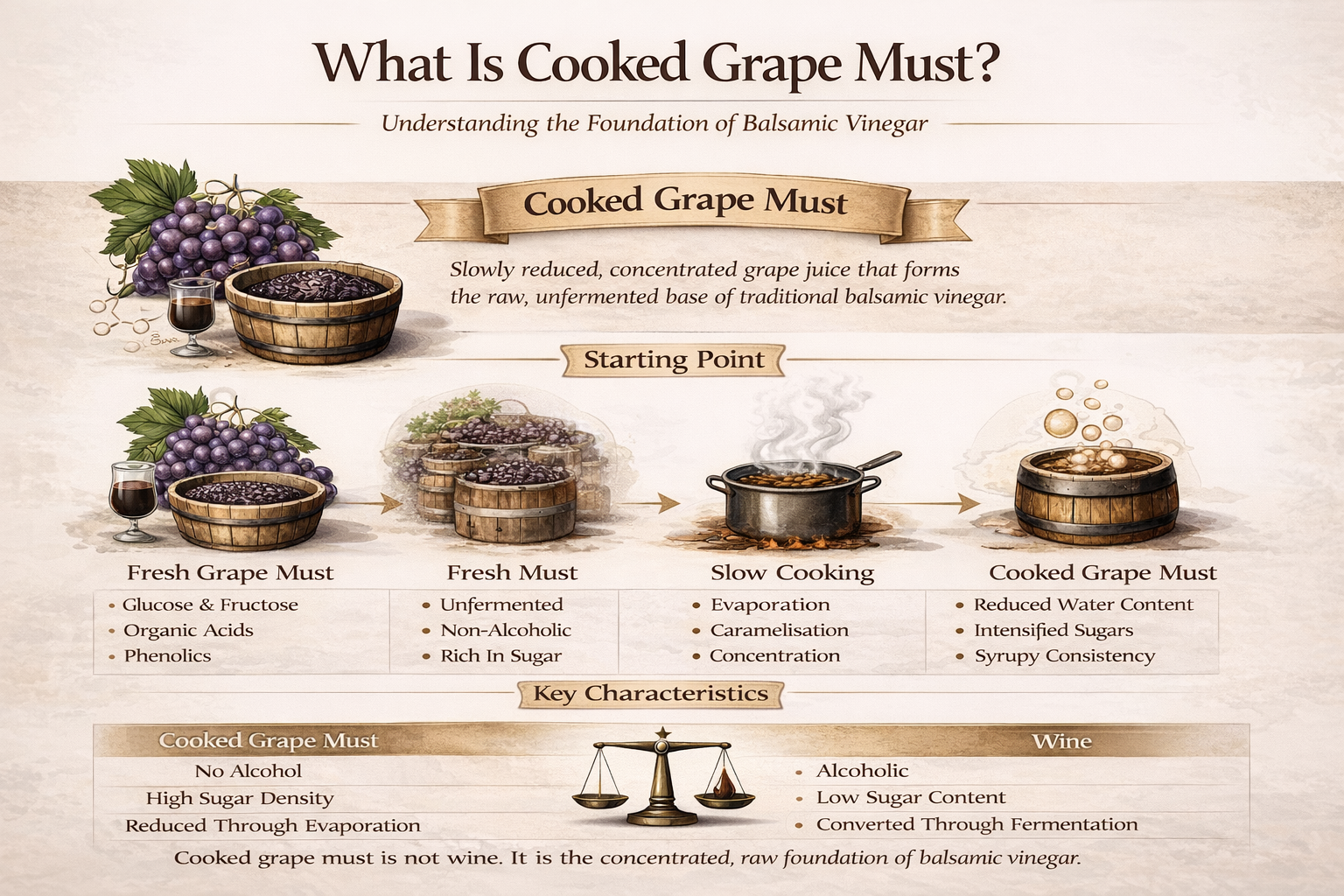
Gentle heat reduces water content and stabilises the liquid. Sugars become more concentrated, aromas deepen and colour darkens. This is preparation, not finishing; it creates the conditions for the long evolution that follows.
Without this step, the characteristic profile associated with balsamic vinegar would not emerge.
The composition of must is explored in more detail in our guide to cooked grape must.
Fermentation: nature at work
After cooking, microorganisms begin their task.
Yeasts convert sugars into alcohol. This happens gradually and may vary depending on temperature and environment. Fermentation is essential because it prepares the stage for acetification, the process that will ultimately create vinegar.
Anyone trying to understand how is balsamic vinegar made must recognise that these transformations are biological, not merely mechanical.
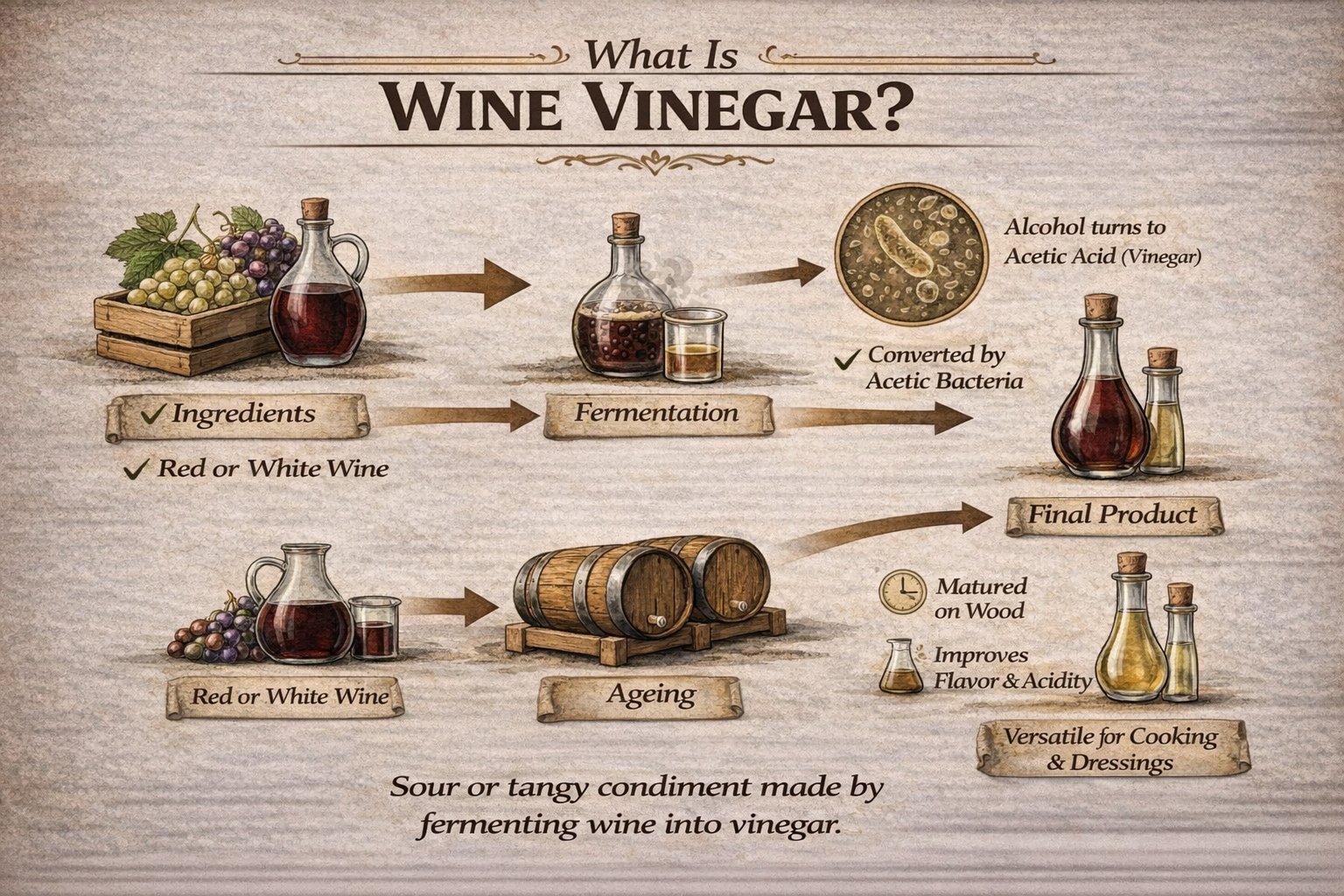
Readers often continue this topic by comparing it with what is wine vinegar.
Acetification: turning alcohol into acidity
Acetic bacteria now enter the scene.
They transform alcohol into acetic acid, giving vinegar its structure and stability. The balance between remaining sweetness and developing acidity becomes one of the defining characteristics of the final liquid.
Control at this moment is delicate. Too aggressive, and harmony is lost; too slow, and the process may stall.
Aging in wooden barrels
When people ask how is balsamic vinegar made, they often imagine barrels, and for good reason.
Wood is not simply a container. It allows slow oxygen exchange and gradual evaporation. Volume decreases year after year, concentrating flavour, density and perfume.
Different woods contribute different aromatic nuances. Over time, sharper notes soften and integration improves.
This stage may last from short periods to many years depending on category and intention.
Thickness, however, does not automatically indicate superiority, as discussed in does thicker mean better.
Time as an ingredient
At this point, it becomes clear that answering how is balsamic vinegar made requires acknowledging time as a real component.
Duration influences viscosity, colour, aromatic complexity and persistence. It shapes personality more profoundly than any single technical intervention.
However, longer is not automatically better for every culinary purpose. A fresher expression may perform more effectively in cooking, while extended aging often favours finishing applications.
These differences are clarified in balsamic vinegar of modena PGI vs Traditional Balsamic Vinegar of Modena PDO explained
Transfers and monitoring
In traditional systems, liquids are moved periodically between barrels of decreasing size.
This maintains balance across the set and compensates for evaporation.
Producers taste, observe and adjust, ensuring continuity rather than dramatic change. The objective is harmony, not surprise.
Modern adaptations
Contemporary production can include temperature control, selected cultures and technical equipment designed to ensure reliability and food safety.
These adaptations allow wider distribution and consistent supply while still following the same conceptual pathway. The fundamentals remain connected to grape must, fermentation and maturation.
Understanding this helps clarify how diverse expressions can exist within the same family.
Why production explains price differences
Once the mechanics are visible, cost variation becomes easier to interpret.
Years of storage, loss of volume, labour and certification all accumulate. Products released earlier or made in larger quantities naturally operate under different economic conditions.
Knowing how is balsamic vinegar made turns apparent mystery into logic.
The method of production ultimately determines behaviour in the kitchen.
Acidity level, sweetness, aromatic intensity and texture guide how much should be used and with which foods. The cook who understands origin and transformation is better equipped to create balance.
Continuing the journey of understanding
Learning how is balsamic vinegar made is often the moment when curiosity expands into deeper exploration.
Readers typically continue toward:
classification systems
authenticity markers
label interpretation
storage life
culinary pairing logic
Each of these topics builds upon the foundation established by production knowledge.
Practical identification methods are outlined in how to recognise authenticity
Once the mechanics of transformation are visible, many purchasing dilemmas resolve themselves.
A consumer comparing options will immediately recognise that duration of aging, evaporation loss and manual supervision influence scarcity. What previously appeared as marketing becomes measurable reality.
This is why learning how is balsamic vinegar made naturally leads toward the broader decision-making guide on how to choose without regret. Production knowledge provides the vocabulary necessary for intelligent selection.
It also helps dismantle persistent myths. For example, density alone cannot confirm excellence — a topic explored in detail in does thicker mean better.
Similarly, curiosity about ingredients often continues toward is caramel allowed (No of course!), where category rules are explained with precision.
Even practical matters such as longevity depend on understanding acidity and stability, themes addressed in does it go off.
By connecting these subjects, the production process becomes the foundation of a much larger map of understanding.
Production knowledge becomes especially useful when reading our guide on how to choose without regret.
Understanding production also means understanding oversight.
While techniques may vary depending on category, reputable balsamic vinegars operate within recognised regulatory environments designed to protect consumers and preserve identity.
Before bottling, liquids are evaluated for parameters such as acidity, density and organoleptic coherence. The goal is not uniform taste, but conformity to the expectations of the designation under which the product will be sold.
Traceability systems allow each batch to be followed back through stages of maturation. This protects both producers and buyers, reinforcing transparency in a market where names alone can otherwise create confusion.
For readers exploring authenticity further, our guide on how to recognise authenticity explains which visual and documentary cues deserve attention.
Likewise, the article on how to read a label provides practical tools for interpreting ingredient lists and official markings.
Regulatory frameworks are not obstacles to creativity; they are reference points that maintain clarity between different families of products. Without them, it would become increasingly difficult to explain variation in price and reputation.
Official oversight and category protection are coordinated by the Consorzio Tutela Aceto Balsamico di Modena.
Once the mechanics of transformation are visible, many purchasing dilemmas resolve themselves.
A consumer comparing options will immediately recognise that duration of aging, evaporation loss and manual supervision influence scarcity. What previously appeared as marketing becomes measurable reality.
This is why learning how is balsamic vinegar made naturally leads toward the broader decision-making guide on how to choose without regret. Production knowledge provides the vocabulary necessary for intelligent selection.
It also helps dismantle persistent myths. For example, density alone cannot confirm excellence — a topic explored in detail in does thicker mean better.
Similarly, curiosity about ingredients often continues toward is caramel allowed, where category rules are explained with precision.
Even practical matters such as longevity depend on understanding acidity and stability, themes addressed in does it go off.
By connecting these subjects, the production process becomes the foundation of a much larger map of understanding.