
The Science of Balsamic Vinegar
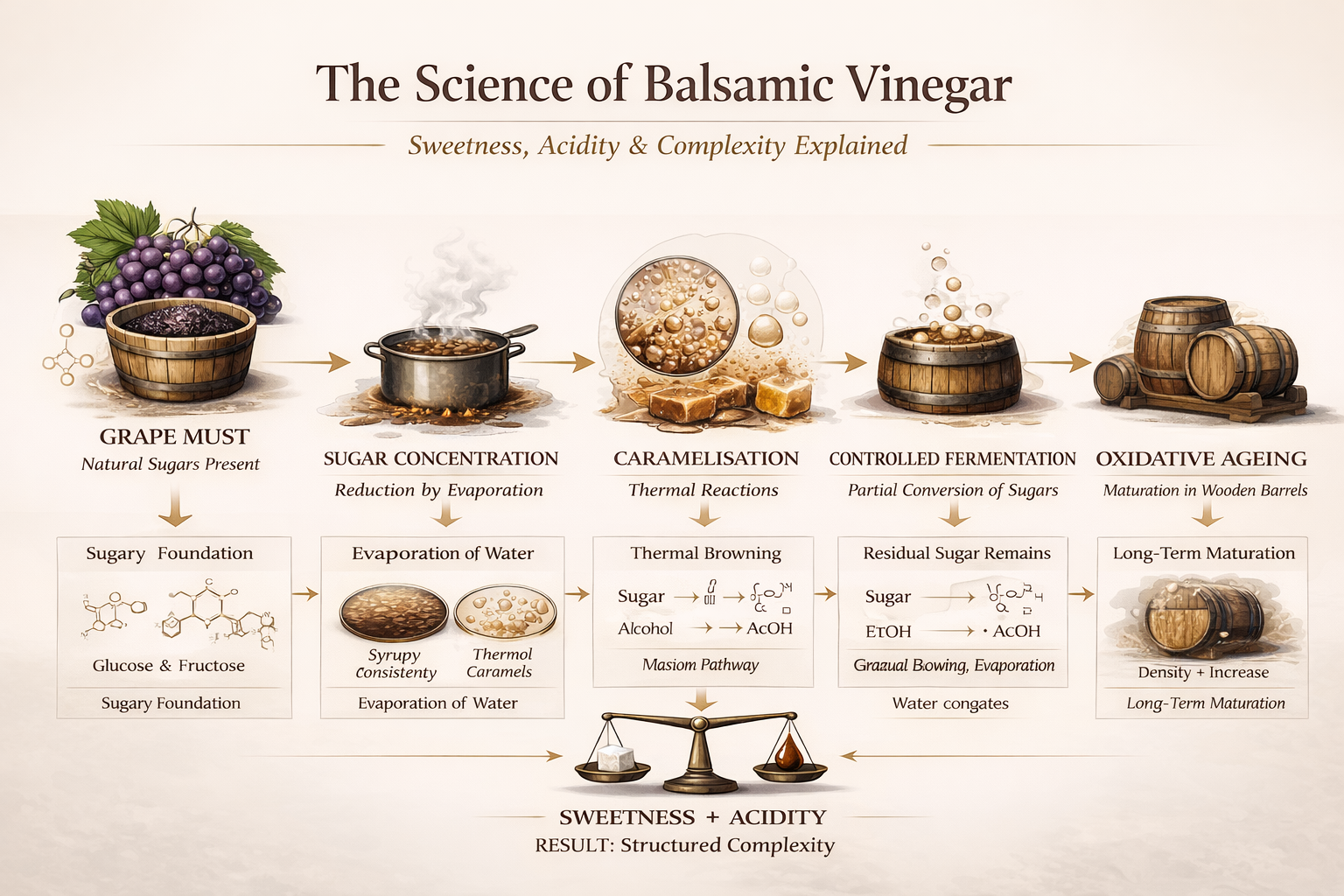
Balsamic vinegar is often described in poetic terms — dense, sweet, complex, aged.
But beneath its sensory profile lies a precise sequence of chemical and physical transformations.
Understanding the science of balsamic vinegar means examining four core mechanisms:
Sugar concentration
Caramelisation
Controlled fermentation
Oxidative ageing
Each stage contributes to sweetness, acidity, texture, and aromatic complexity.
1. Grape Must: The Chemical Foundation
Unlike wine vinegar, balsamic vinegar begins with fresh grape must.
Grape must contains:
-
Glucose
-
Fructose
-
Organic acids
-
Water
-
Phenolic compounds
The presence of natural sugars from the beginning is the structural reason balsamic can develop sweetness.
| Starting Material | Sugar Content | Outcome |
|---|---|---|
| Wine | Low (after fermentation) | Sharp vinegar |
| Grape Must | High natural sugars | Potential sweetness |
The science begins here.
2. Reduction and Sugar Concentration
When grape must is slowly cooked, water evaporates.
Evaporation increases the relative concentration of sugars.
This is a physical transformation, not a chemical addition.
Less water = higher sugar density.
During reduction:
-
Brix level increases
-
Viscosity rises
-
Thermal reactions begin
Concentration is the first driver of sweetness.
3. Caramelisation and Maillard Reactions
As heat continues, sugars undergo caramelisation.
Caramelisation:
-
Breaks down sugar molecules
-
Forms brown pigments
-
Produces complex aromatic compounds
This explains colour development in dark balsamic vinegar.
It is distinct from caramel colouring (E150d), which is a permitted additive in some IGP formulations.
The deep brown colour of traditional DOP balsamic develops naturally through caramelisation and ageing.
4. Controlled Fermentation
The fermentation pathway in balsamic vinegar differs from standard vinegar production.
Standard pathway:
Sugar → Alcohol → Acetic Acid (complete conversion)
Balsamic pathway:
Sugar → Partial Alcohol → Partial Acetic Acid
Because fermentation is gradual and incomplete, residual sugars remain.
This is why balsamic vinegar tastes sweet and acidic simultaneously.
| Process Stage | Sugar Level | Acidity | Balance |
|---|---|---|---|
| Raw Must | High | Low | Sweet |
| After Cooking | Higher | Low | Concentrated |
| After Fermentation | Moderate | Moderate | Sweet-acid balance |
Sweetness is preserved, not eliminated.
5. Oxidative Ageing in Wooden Barrels
In long-aged products such as:
-
Aceto Balsamico Tradizionale di Modena DOP
-
Aceto Balsamico Tradizionale di Reggio Emilia DOP
The vinegar matures in a series of wooden barrels.
Ageing contributes:
-
Continued evaporation
-
Micro-oxidation
-
Aromatic complexity
-
Increased density
Viscosity enhances perceived sweetness.
Texture influences sensory interpretation.
6. Why Is Balsamic Vinegar Sweet?
Sweetness in balsamic vinegar is the result of:
-
Natural grape sugars
-
Concentration through reduction
-
Partial fermentation
-
Long-term ageing
It is not typically the result of added sugar in authentic production.
| Mechanism | Contribution to Sweetness |
|---|---|
| Grape Must | Natural sugar source |
| Reduction | Sugar concentration |
| Partial Fermentation | Residual sugar remains |
| Ageing | Perceived sweetness intensifies |
Sweetness is structural, not artificial.
7. DOP vs IGP: Scientific Differences
| Feature | Traditional DOP | Aceto Balsamico di Modena IGP |
|---|---|---|
| Base Ingredient | 100% cooked grape must | Must + wine vinegar |
| Additives | None permitted | Caramel permitted up to 2% |
| Ageing | Long barrel system | Minimum regulated ageing |
| Sweetness Driver | Natural concentration + time | Must proportion dependent |
Under Aceto Balsamico di Modena IGP regulations, caramel may be used for colour stabilisation. However, sweetness primarily depends on grape must percentage.
8. The Balance of Sweetness and Acidity
Balsamic vinegar is defined by tension.
Sweetness alone would feel heavy.
Acidity alone would feel sharp.
The science of balsamic lies in equilibrium between:
-
Residual sugars
-
Acetic acid
-
Aromatic volatiles
-
Viscosity
When properly produced, the result is structured harmony.
Conclusion: The Architecture of Sweetness
The science of balsamic vinegar reveals that its sweetness is not accidental.
It is engineered through:
-
Controlled evaporation
-
Thermal transformation
-
Managed fermentation
-
Slow oxidative ageing
Understanding these mechanisms allows consumers to interpret labels, price differences, and flavour profiles with clarity.