
What Is Cooked Grape Must?
The Foundation of Balsamic Vinegar
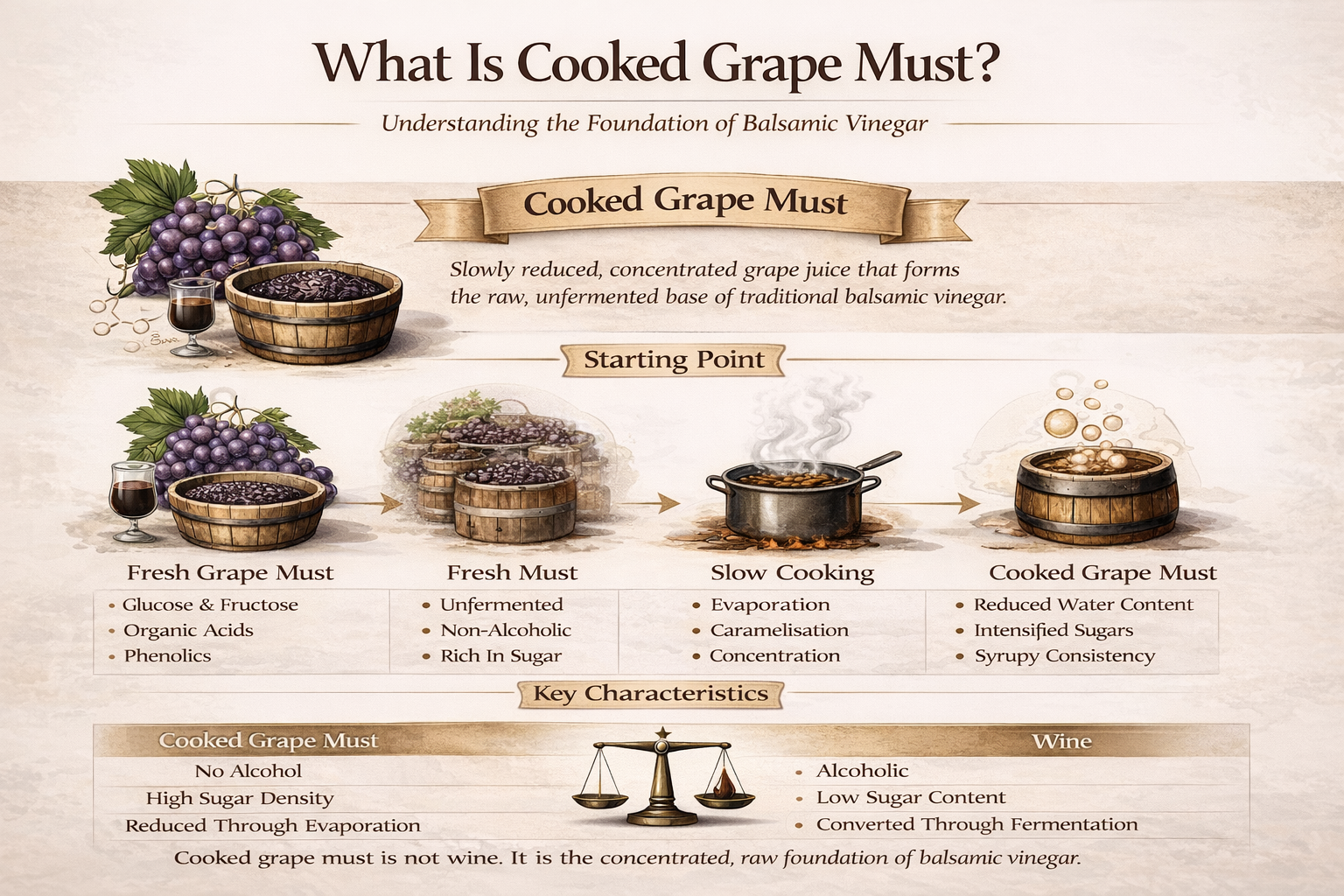
Cooked grape must is the concentrated juice of freshly pressed grapes that has been slowly heated to reduce water content and intensify natural sugars. It forms the structural and regulatory foundation of traditional balsamic vinegar.
In Italian, it is known as mosto cotto.
Understanding cooked grape must is essential to understanding balsamic vinegar itself. It is not wine. It is not vinegar. It is the raw, unfermented starting material that defines sweetness, density, and ageing potential.
From Fresh Grapes to Cooked Grape Must
The process begins immediately after harvest.
Fresh grapes are crushed to release juice, skins, seeds, and pulp. This mixture is called grape must. At this stage, it contains:
Glucose
Fructose
Organic acids
Water
Phenolic compounds
Unlike wine production, where fermentation begins quickly, balsamic production starts with heat.
The grape must is transferred to large open vats and slowly heated. During this stage:
Water evaporates
Sugars concentrate
Density increases
Colour deepens
Cooked grape must is created through reduction, not fermentation.
This distinction is critical.
Why Cook the Must?
The purpose of cooking grape must is concentration.
Evaporation reduces water content and increases sugar density. This produces a viscous liquid with a higher Brix level than fresh juice.
The cooking process also initiates early thermal reactions, including controlled caramelisation, which contributes to colour development.
The more water evaporates, the richer and denser the must becomes.
This is the structural basis of sweetness in traditional balsamic vinegar.
For a broader explanation of how this fits into the production chain, see our guide to the science of balsamic vinegar.
Cooked Grape Must vs Wine
It is important not to confuse cooked grape must with wine.
| Feature | Cooked Grape Must | Wine |
|---|---|---|
| Fermented? | No | Yes |
| Alcohol Present? | No | Yes |
| Sugar Content | High (concentrated) | Low (after fermentation) |
| Role in Balsamic | Primary structural base | Secondary component in IGP blends |
In traditional DOP balsamic, cooked grape must is the only permitted ingredient.
In regulated IGP production such as Aceto Balsamico di Modena IGP, The must is blended with wine vinegar, but it remains the sweetness driver.
The Role of Cooked Grape Must in Ageing
The cookedgrape must is not yet vinegar. It must undergo gradual fermentation and ageing.
In long-aged products such as:
Aceto Balsamico Tradizionale di Modena DOP
Aceto Balsamico Tradizionale di Reggio Emilia DOP
the concentrated must is transferred into wooden barrel batteries, where:
Partial fermentation occurs
Acetic bacteria convert part of the sugars
Oxidation deepens complexity
Evaporation continues
Because the must begins highly concentrated, residual sugars remain even after fermentation.
This is why balsamic vinegar retains sweetness.
Does Cooked Grape Must Contain Added Sugar?
Authentic cooked grape must contains no added sugar.
Its sweetness comes exclusively from natural grape sugars concentrated during reduction.
If a product lists sugar separately in the ingredient declaration, it is not traditional cooked grape must.
Consumers can verify composition by reviewing labels carefully.
Thermal Chemistry and Caramelisation
During cooking, sugars undergo mild thermal transformation.
This is not the same as adding caramel colouring.
Caramelisation is a natural reaction that begins when sugars are heated. It contributes to darkening and flavour complexity.
This reaction is foundational to colour development in traditional balsamic.
Why It Matters
It is not simply an ingredient. It is the architectural base of balsamic vinegar.
Without it, balsamic would taste like wine vinegar.
Its concentration determines:
Sweetness
Viscosity
Ageing potential
Aromatic depth
In traditional DOP production, it is the only ingredient allowed.
In IGP production, it defines sweetness depending on its proportion in the blend.
Final Definition
Cooked grape must is slowly reduced grape juice whose natural sugars have been concentrated through evaporation. It is unfermented at the time of production and serves as the structural base of balsamic vinegar.
Understanding cooked grape must clarifies why balsamic vinegar is sweet, dense, and capable of long ageing.
It is not a flavour additive. It is the origin of structure.